
Semi-Metallic / Metal Insert / Soft Sealing Body
Metal-Reinforced Soft Gaskets
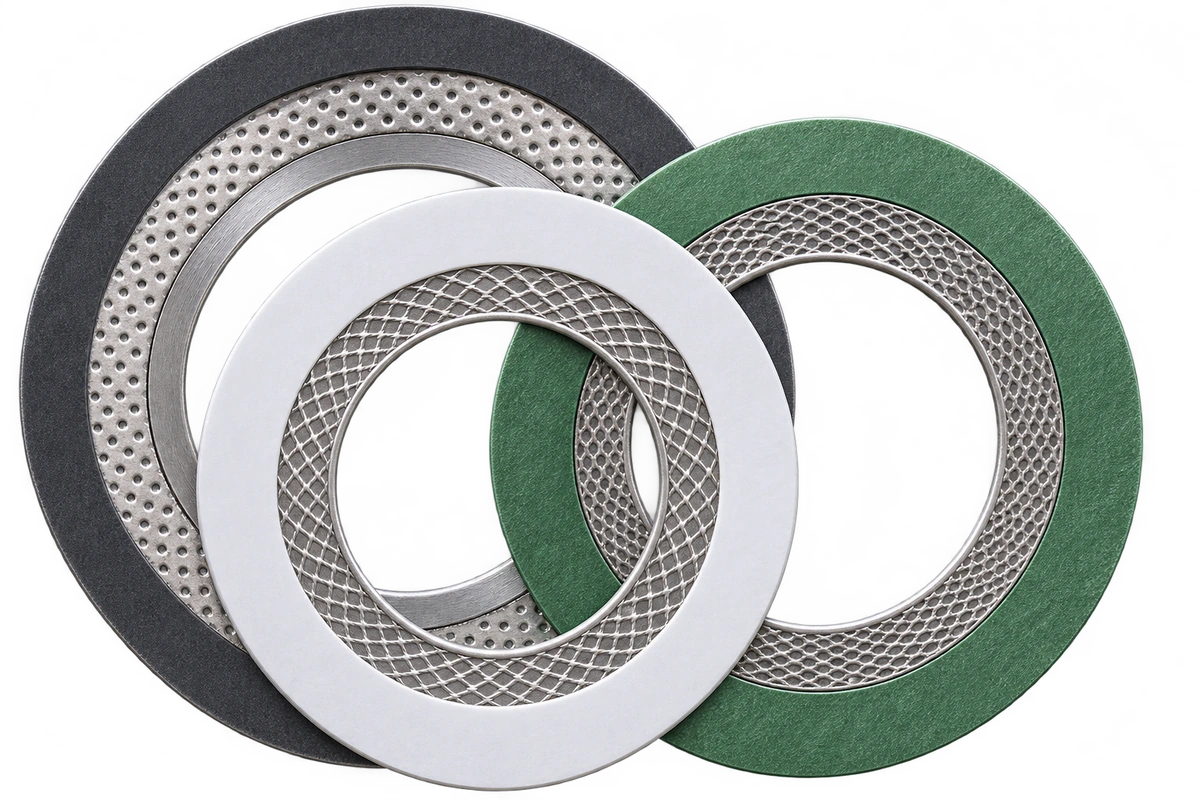
A soft sealing sheet contains metal reinforcement. Specify the sheet grade, insert form and finished cut dimensions together.
Product Overview

| Construction | The soft sealing body contains an internal metal layer or insert, such as stainless steel foil in flexible graphite sheet. |
|---|---|
| Nominal size range | For covered flange patterns, use the listed DN and PN in EN 1514-1 or the listed size and Class in EN 12560-1. Equipment outlines follow the approved drawing. See dimensional references. |
| Dimension range | Use the applicable table or drawing for ID, OD and any bolt holes. Confirm finished thickness and internal reinforcement separately. |
| Material specifications | Specify the finished sheet grade, metal insert grade and form, and total gasket thickness. See material options. |
Key Features & Material Options
Key features
- Soft sealing faces
- The outer sealing material is specified as part of the reinforced sheet grade.
- Internal reinforcement
- Smooth foil and tanged stainless steel are distinct reinforcement forms.
- Cut outline
- Check whether the flange uses an inside-bolt-circle or full-face pattern.
| Soft sheet | Flexible graphite is a documented example. Specify sheet grade and layer construction. |
|---|---|
| Metal reinforcement | Define the metal grade, insert form and layer count using the selected sheet specification. |
Confirm material grade and availability with your enquiry.
Standards, Dimensions & Pressure Classes
| EN 1514-1 | Dimensional reference for covered flat gaskets with or without inserts for PN flanges. |
|---|---|
| EN 12560-1 | Dimensional reference for covered flat gaskets with or without inserts for Class-designated flanges. |
| EN 13555 | Request data for the actual sheet construction and thickness if the joint design calls for these parameters. |
Confirm size and fit
Identify the flange designation and gasket pattern. Provide a dimensioned outline for an equipment joint.
Technical Specifications
| Layer build | Identify the sheet grade, insert type, layers and finished thickness. |
|---|---|
| Drawing details | Define the outline, seating width and positions of bolt holes and cutouts. |
| Assembly conditions | Review seating requirements with the fluid, temperature, pressure and available assembly load. |
Quality & Testing
| Edges and faces | Agree criteria for cut-edge distortion, face damage and separation of layers. |
|---|---|
| Geometry | Verify finished thickness, outline and any hole or cutout positions. |
| Identification | Request the sheet grade and reinforcement information needed for traceability. |
Downloads & Documents
Review the gasket and joint information to specify.
General bolted flange guidance from the Fluid Sealing Association.
List certificate or traceability requirements in your enquiry.
Reference the approved drawing and revision in your enquiry.
Frequently Asked Questions
How does an insert differ from an eyelet?
An insert sits within the body. An eyelet forms around an edge, commonly at the bore. Some designs have both.
Do all reinforced sheets use the same insert?
Insert form and layer count depend on the specified sheet grade. Identify the complete sheet construction.
Request a quote
Include sheet grade, insert type, thickness, flange designation or drawing, and quantity.