
Choose the rubber compound for the service. sales@ferrobend.com +91-8369719424

Non-Metallic / Solid Elastomer

Rubber Gaskets

Solid elastomer gaskets in ring and full-face patterns. Match the exact compound and hardness to the fluid, temperature and available compression.
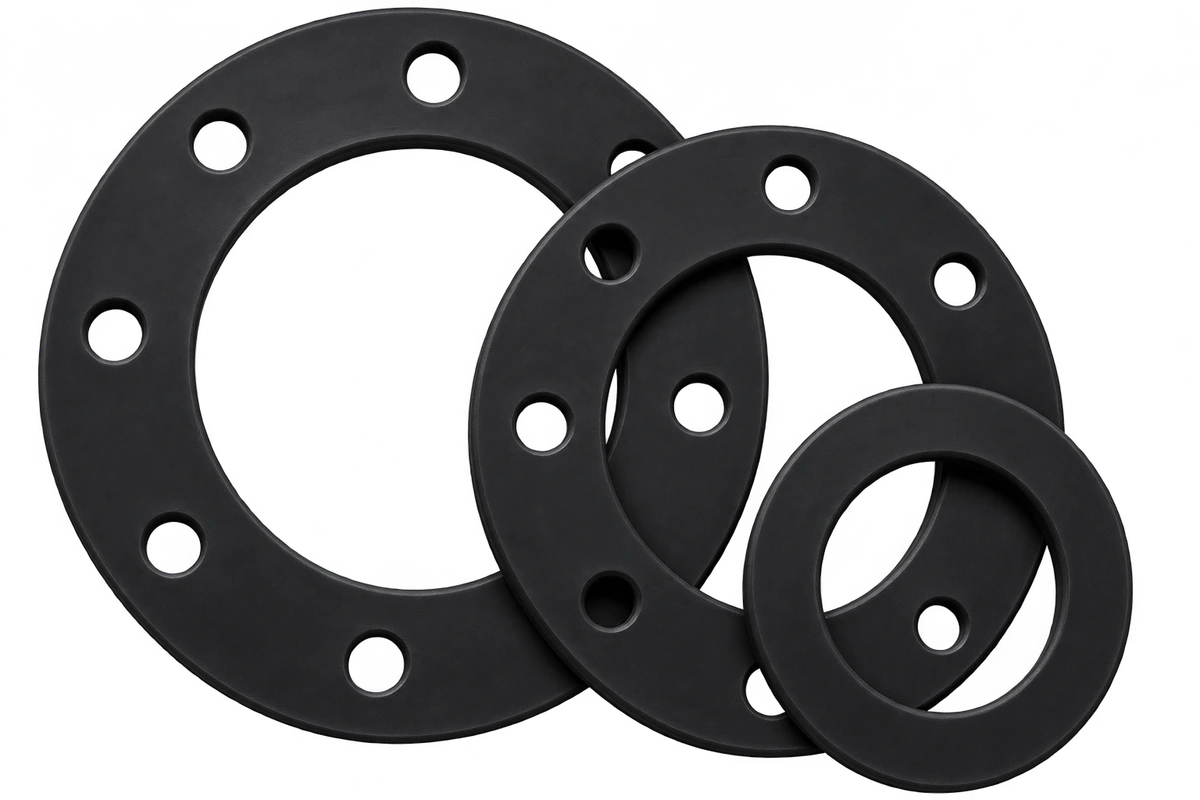
Illustrated solid rubber rings and full-face gaskets

Product Overview

Illustrated solid rubber rings and full-face gaskets
Quick specifications
ConstructionSolid elastomer formed or cut into a flat gasket. Check the cut or moulded profile against the joint drawing.
Nominal size rangeEN 12560-1:2024 covers DN 15–600 for Classes 150, 300, 600 and 900 on specified EN 1759 flanges. Check the exact gasket pattern and table.
Dimension rangeUse the applicable table or approved drawing for ID, OD and thickness. Give hole count, diameter and pitch circle for a full-face gasket.
Material to specifyCompound grade, durometer scale and hardness, plus finished thickness.

Features & Materials

Compound first
EPDM, NBR and FKM are distinct elastomer families. Check compatibility for the actual compound and conditions.
Compression space
Confirm the installation gap and required compression for the selected grade.
Material specification
Hardness methodASTM D2240 is a durometer hardness test. Specify the scale and required hardness for the ordered compound.
Compression setCompare results at the same test method, temperature and duration. A compound’s test result does not establish joint tightness.

Standards & Dimensions

Dimensional references
ASME B16.21Flat gasket dimensions for the flange types and sizes covered by the selected table.
EN 1514-1:2024For covered PN flange and pipe systems, the scope extends to PN 63 and DN 4000. Check the listed flange and gasket combination.
EN 12560-1:2024Flat gaskets for covered EN 1759 flanges. Check the listed DN and Class combinations.

Use these standards for dimensional selection within scope. Confirm grade, thickness, service limits and availability for the joint.

Technical Specifications

Selection and fit
Compound selectionGive the fluid, concentration, design temperature and pressure, with any cleaning or exposure cycles.
Joint geometryConfirm seating width, thickness and the available closed gap or compression range.

Quality & Testing

Inspection requirements to agree
Incoming materialAgree the grade identification and hardness verification.
Finished gasketCheck thickness, shape, bolt holes and any surface damage against the drawing.

FAQs

Does hardness establish chemical resistance?

Hardness describes indentation response. Verify chemical compatibility from grade-specific data for the service.

Request a quote

Provide the rubber compound, hardness, drawing or flange designation, duty and quantity.

Open enquiry form